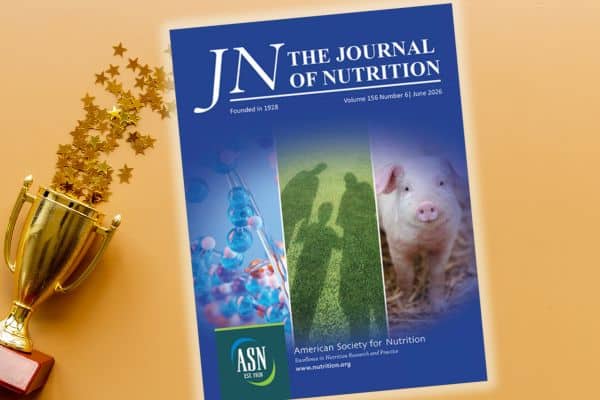
Nutrition science is increasingly informing decisions across healthcare, public policy, agriculture, and everyday health. The 2026 awards from the American Society of Nutrition’s (ASN) The Journal of Nutrition recognize outstanding research and reviews that advance understanding across a wide range of nutrition topics, as well as the peer reviewers who make publication of this trusted research possible.
This year’s award-winning papers highlight four distinct but connected areas of nutrition science, including Food Is Medicine initiatives, nutrient metabolism, metabolic liver disease, and protein quality. Together, these articles reflect the breadth of research published in the journal and the growing role of nutrition science in addressing complex health and food system challenges.
The authors and reviewers will be honored at ASN’s NUTRITION 2026 annual meeting, where attendees will have the opportunity to hear leading researchers discuss emerging issues shaping nutrition science and health.
Explore the award-winning papers below, and learn about just a few of the hundreds of reviewers who helped refine these articles into the work you read throughout 2025 and beyond.
The Journal of Nutrition’s Malden Nesheim Nutrition Landscape Award
This award is sponsored by Cornell University’s College of Human Ecology.
Recipients:
- Andrea J. Glenn, PhD, RD, New York University
- Frank B. Hu, MD, PhD, Harvard T.H. Chan School of Public Health
Dr. Hu will present the Malden Nesheim Nutrition Landscape Award lecture at NUTRITION 2026.
Perspective: Food Is Medicine: Hype or Hope?
Why It Matters
Food Is Medicine has gained significant attention as healthcare systems, policymakers, and communities explore ways to integrate nutrition into disease prevention and care. This perspective examines how food-based interventions are being used in healthcare and community settings while also taking a critical look at the evidence supporting these approaches.
The authors highlight both the promise and the hype surrounding Food Is Medicine and identify important gaps that must be addressed to strengthen research, implementation, and policy development.
The paper provides a comprehensive review of a rapidly evolving area of nutrition science. By outlining both opportunities and limitations, the paper provides a roadmap for future research and policy efforts aimed at maximizing the impact of nutrition-focused healthcare interventions.
The Journal of Nutrition’s Milton L. Sunde Award
This award is endowed by the Sunde Family.
Recipients:
- Ruochen Yang, China Agricultural University
- Qiugang Ma, PhD, China Agricultural University
Why It Matters
Calcium and phosphorus are essential nutrients in poultry feed and are critical for bone growth, egg production, and bird health. Improving how birds absorb and use these minerals can strengthen skeletal development while reducing phosphorus waste that can affect the environment.
This study shows that mineral absorption and retention vary across different strains of laying hens and identifies key genes involved in calcium and phosphorus transport. The research also highlights the duodenum as an important site for mineral absorption and storage.
These findings could help the poultry industry tailor feeding strategies for different strains of laying hens to improve animal health, production efficiency, and environmental sustainability.
The Journal of Nutrition’s A. Catharine Ross Award in Experimental Nutrition
This award is sponsored by Research Diets, Inc.
Recipients:
- Emily Berg, MsC, University of Alberta
- Catherine B. Chan, PhD, University of Alberta
Why It Matters
Metabolic dysfunction-associated steatotic liver disease, or MASLD, affects nearly one-third of adults worldwide and currently has few effective treatment options. This study suggests that nonfat milk may help slow early liver-fat buildup by improving how the liver processes and burns fat.
The researchers found that nonfat milk may offer greater protective effects than whole milk by supporting the liver’s ability to metabolize fat more efficiently.
If these findings are confirmed in humans, nonfat milk could become a practical, low-cost dietary approach to help reduce the risk of liver disease and support metabolic health.
The Journal of Nutrition’s Teresa A. Davis Award in Growth and Protein Nutrition
This award is supported by donations to the Teresa A. Davis Award Fund
Recipients:
- Suzane M. Hodgkinson, PhD, MSc, Riddet Institute, Massey University
- Paul J. Moughan, PhD, Massey University
Why It Matters
Accurate amino acid digestibility data are essential for evaluating protein quality, particularly in areas such as global nutrition, child growth, and healthy aging.
This study measured how effectively amino acids from 97 common foods are digested in the small intestine using pigs as a model for human digestion. The researchers found substantial differences in digestibility across food types and produced one of the largest standardized datasets of amino acid digestibility for human foods.
The findings help improve protein quality assessment, diet planning, and understanding of how different foods contribute to amino acid needs. The dataset also strengthens the scientific foundation for calculating the Digestible Indispensable Amino Acid Score, or DIAAS, a method used to evaluate protein quality in foods.
Recognizing Excellence in Peer Review
In addition to honoring outstanding research, The Journal of Nutrition recognizes the dedicated reviewers whose expertise helps uphold the quality and integrity of the scientific record.
Continuing the Conversation at NUTRITION 2026
Together, these award-winning papers and the people who support their publication reflect the expanding scope of nutrition science, from population health and clinical nutrition to animal science and protein quality measurement. They highlight the importance of rigorous evidence in addressing complex health and food system challenges, and demonstrate how nutrition research continues to inform policy, practice, and future innovation.
These award-winning studies represent just a sample of the research and scientific discussions that will be featured at NUTRITION 2026. The authors and reviewers will be recognized during the meeting, where attendees will have opportunities to engage with leading researchers and explore emerging issues shaping the future of nutrition science.
It’s not too late to register for NUTRITION 2026.